Author Archives: ubalaman

ubalaman's avatar

About ubalaman

Ufuk Balaman is the coordinator of the DigiLTE project. He is an Associate Professor of Applied Linguistics in the department of English Language Education at TED University, Türkiye. Using conversation analysis as research methodology, he primarily deals with technology-mediated interaction for L2 learning, teaching and teacher education. Visit his personal website for further info.

[HUMAN] Data session, Maria Vanessa aus der Wieschen- Danish EFL Classrooms, 24 March, 15:00

In our next data session, Maria Vanessa aus der Wieschen (University of Southern Denmark) will present an extract from her corpus of English as a Foreign Language  in Danish young learner classroom interactions. The session will take place in the meeting room of HUMAN Research Centre on the 24th of March, Thursday at 3:00 p.m.

——————————————————————————————

Bir sonraki veri oturumumuzda, University of Southern Denmark doktora öğrencilerinden Maria Vanessa aus der Wieschen, “Danimarkalı Çocuklara Yabancı Dil Olarak İngilizce Öğretimi Sınıfları” veritabanından bir kesit sunacaktır. Oturumumuz 24 Mart Perşembe günü HUMAN Uygulama ve Araştırma Merkezi toplantı odasında saat 15:00’da gerçekleşecektir.


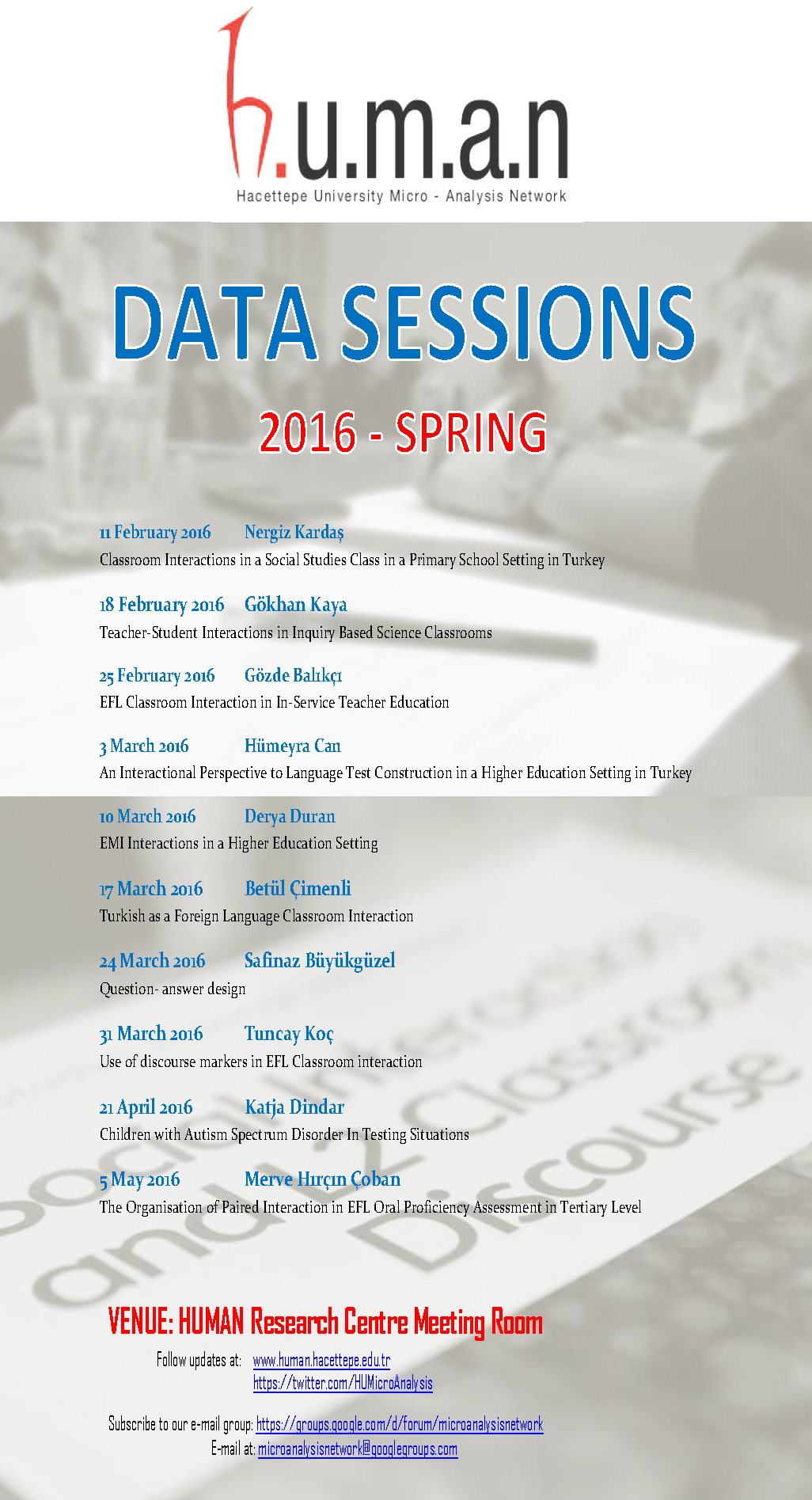
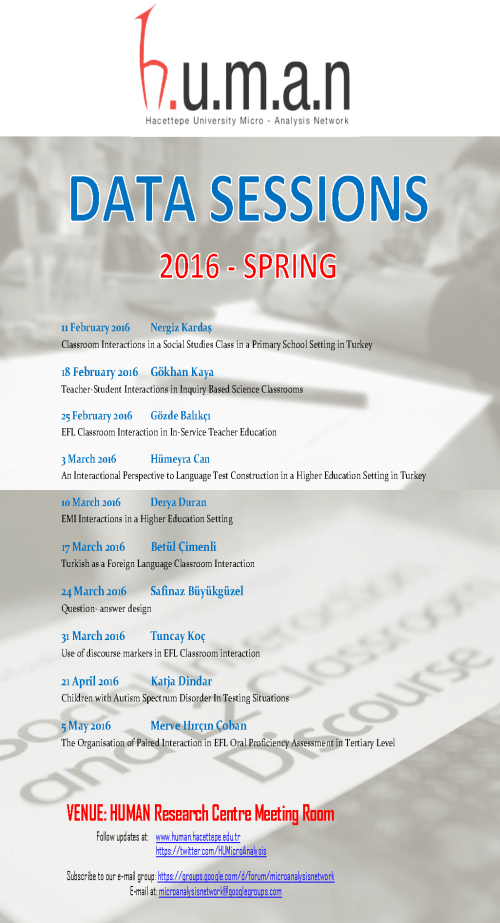
datasessions_afis

Leave a comment

Filed under Uncategorized

[HUMAN] Reading Group Meeting, Epistemics (Heritage, 2012)

The third reading group meeting of the semester will be held next week on the 22nd of March, Tuesday at 15:30 in the meeting room of HUMAN Research Centre. We will discuss another seminal work by Heritage (2012) on epistemics in interaction. Heritage (2012) published two papers in the same issue of the “Research on Language and Social Interaction” journal. The first one framed epistemics for action formation, while the second conceptualised what Heritage termed as epistemic engine. Unlike previous meetings, we expect the participants to read both papers.

Heritage, J. (2012). Epistemics in action: Action formation and territories of knowledge. Research on Language & Social Interaction, 45(1), 1-29.

Heritage, J. (2012). The epistemic engine: Sequence organization and territories of knowledge. Research on Language & Social Interaction, 45(1), 30-52.

Screen Shot 2016-03-13 at 09.44.50Screen Shot 2016-03-13 at 09.45.06

For the structure of reading group meetings (2015), see the list below:

We will start the reading group by summarising the articles, followed by an in-depth discussion of them.

Additionally, you may want to do some of the following in order to prepare for the discussion:

  • Write down any questions you may have about the articles

  • Find one or more passages that you find interesting

  • Think about how the points presented in the articles relate to other theories or to your own research

  • Choose the paper you agree with the most, then pretend to be the devil’s advocate and criticize the authors’ viewpoints

Leave a comment

Filed under Uncategorized

[HUMAN] Data session, EMI Interactions, 10 March, 15:00

In our next data session, Derya Duran (Hacettepe ELT, PhD Candidate) will present an extract from her corpus of EMI interactions in a higher education setting. The session will take place in the meeting room of HUMAN Research Centre on the 10th of March, Thursday at 3:00 p.m.
——————————————————————————————
Bir sonraki veri oturumumuzda, Hacettepe ELT araştırma görevlilerinden Derya Duran, “Yüksek öğretimde öğretim dili olarak İngilizce etkileşimlerinden” oluşan  veritabanından bir kesit sunacaktır. Oturumumuz 10 Mart Perşembe günü HUMAN Uygulama ve Araştırma Merkezi toplantı odasında saat 15:00’da gerçekleşecektir.
——————————————————
Lors de notre prochaine session de donnée Derya Duran présentera un exemple de son corpus. La session prendra place à la salle de réunion de HUMAN Research Center le jeudi 10 mars à 15 h. Nous espérons vous voir nombreux ce jeudi.
datasessions_afis

Leave a comment

Filed under Uncategorized

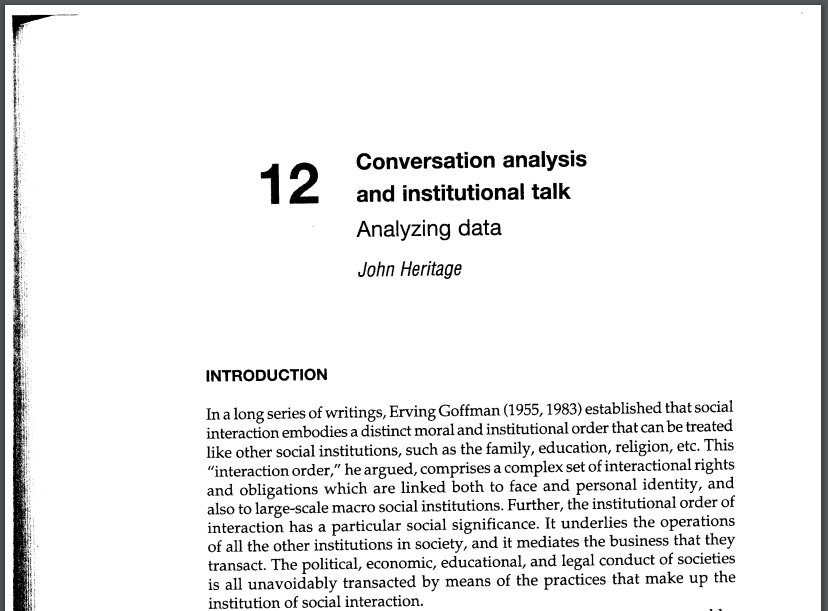
[HUMAN] Reading Group Meeting, Institutional Talk (Heritage, 1997)

The second reading group meeting of the semester will be held next week on the 8th of March, Tuesday at 15:30 in the meeting room of HUMAN Research Centre. Following the lively discussion we had last week on the systematics of turn-taking, we will read and discuss another seminal work, from Heritage (1997) on institutional talk and conversation analysis.

Heritage, J. (1997).Conversation analysis and institutional talk: analyzing data. In David Silverman (ed.) Qualitative Research: Theory, Method and Practice. London: Sage: 161-182.

Screen Shot 2016-03-02 at 20.34.07

For the structure of reading group meetings (2015), see the list below:

We will start the reading group by summarising the articles, followed by an in-depth discussion of them.

Additionally, you may want to do some of the following in order to prepare for the discussion:

  • Write down any questions you may have about the articles

  • Find one or more passages that you find interesting

  • Think about how the points presented in the articles relate to other theories or to your own research

  • Choose the paper you agree with the most, then pretend to be the devil’s advocate and criticize the authors’ viewpoints

Leave a comment

Filed under Uncategorized

Parallel Worlds? Early Foreign Language Teaching and Teacher Education in Denmark and Turkey

HUMAN Research Centre and University of Southern Denmark partners in a networking project funded by Danish Agency for Science Technology and Innovation. The project aims to contribute to theory and practice development in early English language teaching and teacher training programs. Based on Conversation Analysis methodology, the project partners will scrutinise the practices in early English languge teaching and learning, English teachers’ orientation to the availability in society, and how any differences between Denmark and Turkey in the availability of English in society may affect English teaching and the training of English teachers. Three workshops (two in Turkey, one in Denmark) will be organised for the development of project outputs and planning of future collaborations.

parallel-worlds

Leave a comment

Filed under Uncategorized

[HUMAN] Reading Group Meeting, Turn-taking (SSJ, 1974)

In the first reading group of the semester, we will read, examine, and discuss theclassic/masterpiece work in Conversation Analysis literature; “A simplest systematics for the organization of turn-taking for conversation” by Harvey Sacks, Emmanuel Schegloff, and Gail Jefferson  (1974). The meeting will be held in the meeting room of HUMAN Research Centre, on the 23rd of February, 15:30. Click the abstract of the article below to get access or contact me at ubalaman[at]gmail.com.

You may also find the details (2015) below useful for the structure of reading group meetings.

We will start the reading group by summarizing the articles, followed by an in-depth discussion of them.

Additionally, you may want to do some of the following in order to prepare for the discussion:

  • Write down any questions you may have about the articles

  • Find one or more passages that you find interesting

  • Think about how the points presented in the articles relate to other theories or to your own research

  • Choose the paper you agree with the most, then pretend to be the devil’s advocate and criticize the authors’ viewpoints

Leave a comment

Filed under Uncategorized

Reading Group Meetings in Spring, 2016

HUMAN Research Centre vice-directors Safinaz Büyükgüzel and Ufuk Balaman will lead the organisation of 6 reading group meetings this semester. The first meeting of the semester will start with a classic; Sacks et. al’s (1974) turn-taking paper and continue with meetings on institutional talk (Heritage, 1997), epistemics in interaction (Heritage, 2012a, b), interactional competence (Pekarek Doehler & Pochon-Berger, 2015); participation (Goodwin, 2007), and multimodality (Mondada, 2007). The access information to the papers will be provided via e-mail (Google e-mail group) prior to the meetings. Make sure that you are subscribed to e-mail group if you would like to pay a visit.


HUMAN Araştırma Merkezi, 2016 yılı Bahar döneminde, Safinaz Büyükgüzel ve Ufuk Balaman’ın öncülüğünde Okuma Grubu Toplantıları  gerçekleştirmeye devam edecektir. İlk toplantı, bir klasik olan “Söz Sırası Alımı” (Sacks et. al., 1974) çalışması üzerine tartışmalar ile başlayacaktır. Takip eden haftalarda ise kurumsal etkileşim (Heritage, 1997), etkileşimde epistemiks (Heritage, 2012a, b), etkileşimsel yeti (Pekarek Doehler & Pochon-Berger, 2015), katılım (Goodwin, 2007) ve çokkiplilik (Mondada, 2007) konuları üzerine başyapıt çalışmalar toplantıların gündemini oluşturacaktır. İlgili çalışmalara yönelik bilgiler e-posta grubumuzda paylaşılacaktır.

readinggroup_afis

Go to our Contact page to find details about the directions to the data sessions venue.

Leave a comment

Filed under Uncategorized

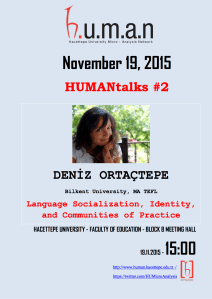
HUMANtalks #2 – Deniz Ortaçtepe – Language Socialization, Identity, and Communities of Practice

afis

HUMAN Research Centre organises the second seminar of HUMANtalks series. Deniz Ortaçtepe will give a talk on Language Socialization, Identity, and Communities of Practice. Dr. Ortaçtepe completed her BA (in ELT) and MA degrees (in Educational Sciences) at Bogazici University, Turkey. After working in Turkey for several years both as a research assistant and as an English teacher, in 2007 she moved to the United States to pursue her doctoral degree. In May 2011, she received her doctorate degree in Curriculum and Instruction at the State University of New York-Albany, where she was also teaching academic writing to graduate students. She is currently teaching in the MA TEFL program at Bilkent University. Her research interests are second language socialization, teacher development, intercultural pragmatics, and sociolinguistics.

Selected publications:

Ortaçtepe, D. (2015). EFL Teachers’ Identity (Re) Construction as Teachers of Intercultural Competence: A Language Socialization Approach. Journal of Language, Identity & Education, 14(2), 96-112.

Ortactepe, D. (2014). Common Ground for Positioning: A discourse Analysis on Second Language Socialization. Hacettepe Üniversitesi Eğitim Fakültesi Dergisi, 29(29-2).

Ortaçtepe, D. (2013). “This Is Called Free-Falling Theory not Culture Shock!”: A Narrative Inquiry on Second Language Socialization. Journal of Language, Identity & Education, 12(4), 215-229.

Ortaçtepe, D. (2013). Formulaic language and conceptual socialization: The Route to becoming nativelike in L2. System, 41(3), 852-865.

The talk will be delivered at 15:00, on the 19th of November in the Faculty of Education Block-B Meeting Hall. We would like to invite researchers in and beyond Ankara to Dr. Ortaçtepe’s HUMANtalks seminar.

Best regards,

Ufuk Balaman

1 Comment

Filed under Uncategorized

The Second Reading Group Meeting – Usage-Based Linguistics and CA

Thanks for the lively discussions during our first reading group last week.

The next reading group is going to take place on Wednesday, July 22nd at 3PM, in the meeting room of the department of foreign language education, 3rd floor.

The topic for the next reading group is “Usage-Based Linguistics/Conversation Analysis Interface”. We’re going to read an article by Søren W. Eskildsen about his longitudinal study in which he uses Usage-Based Linguistics (UBL) and Conversation Analysis (CA) to track how two L2 learners learn L2 negation constructions. He argues that CA should be used as a complementary tool in UBL studies.

Eskildsen, S. W. (2012). L2 negation constructions at work. Language Learning, 62(2), 335-372.

Structure of the reading group:

We will start the reading group by summarizing the article, followed by an in-depth discussion. To prepare for the reading group, please read the article.

Additionally, you may want to do some of the following in order to prepare for the discussion:

Write down any questions you may have about the article
Find one or more passages that you find interesting
Think about how the points presented in the article relate to other theories or to your own research
Pretend to be the devil’s advocate and criticize the author’s viewpoints

In the future reading groups, we’re going to talk about:

CA replication (Markee 2015)
Experimental CA (Voutilainen et al 2015)
Ethnography/Micro-analysis (Cekaite 2007)
Knowledge displays (Koole 2010)
CA-for-SLA (TBD)

Hope to see you next week! 🙂

Maria Vanessa Aus Der Wieschen

Leave a comment

Filed under Uncategorized

The First HUMAN Reading Group Meeting

We are pleased to announce that HUMAN Research Centre will start organising regular reading group meetings. Our visiting researcher from University of Southern Denmark, Maria Vanessa aus der Wieschen has taken the initiative to lead the event for whole summer. Find the details for the structure and content of the first meeting below.

In our reading group we will discuss Conversation Analysis (CA) classics as well as state-of-the art articles and some thought-provoking, untraditional CA work

We will meet every other week, and the first reading group session will be on the 8th of July at 3:00 pm. We are going to meet in the meeting room of the department of foreign language education, 3rd floor.

Readings for the first reading group:

We’re going to discuss T. Stiver’s 2015 article on formal coding in CA, and two responses to this article.

– Stivers, T. (2015). Coding social interaction: A heretical approach in conversation analysis?. Research on Language and Social Interaction, 48(1), 1-19.

– Steensig, J., & Heinemann, T. (2015). Opening up codings?. Research on Language and Social Interaction, 48(1), 20-25.

– Nishizaka, A. (2015). Facts and Normative Connections: Two Different Worldviews. Research on Language and Social Interaction, 48(1), 26-31.

Structure of the reading group:

We will start the reading group by summarizing the articles, followed by an in-depth discussion of them. To prepare for the reading group, please read the three articles.

Additionally, you may want to do some of the following in order to prepare for the discussion:

  • Write down any questions you may have about the articles
  • Find one or more passages that you find interesting
  • Think about how the points presented in the articles relate to other theories or to your own research
  • Choose the paper you agree with the most, then pretend to be the devil’s advocate and criticize the authors’ viewpoints

In the future reading groups, we’re going to talk about:

–          Usage-based linguistics/CA interface (Eskildsen)

–          CA replication (Markee 2015)

–          CA-for-SLA (one of the classics, or something new or untraditional?)

–          Ethnography/Micro-analysis (Cekaite 2007)

–          Experimental CA

–          Knowledge displays (Koole 2010)

Maria Vanessa aus der Wieschen

PhD Fellow, University of Southern Denmark, Department of Design and Communication
4 Comments

Filed under Uncategorized